What is the best way to rate films?

Ask ten people how to rate a film and you'll get ten answers — five stars, a 1–10, thumbs up or down, a letter grade. They all sort of work. And they all make the same quiet compromise: squeeze a complicated thing into a single number, and lose the most interesting part along the way.
So what's the best way to rate a film? Start with what the common systems get wrong.
The problem with one number
- Five stars (Letterboxd): simple, but the three-star middle is a shrug, and one figure can't separate a film's great ending from its other characteristics.
- 1 - 10 crowd averages (IMDb): the most familiar and recognizable scale, the industry standard — but what really is the difference between a 7.7 and a 7.8? Too much granularity, without actually telling you why a film is rated what it is.
- Percentages (Rotten Tomatoes): a headcount of positive reviews, not a measure of quality — 95% approval is not the same as being 95% good. And they have the same too-fine granularity problem: what really is the difference between 82% and 83%?
Every one of them answers "what did people rate it?" None of them answers "why is it rated what it is?" Quartile brings quality control through our formula, and gives viewers the satisfaction of knowing exactly why a film is rated how it is — providing much more valuable information for their viewing decisions.
A better way: rate the parts, not just the whole
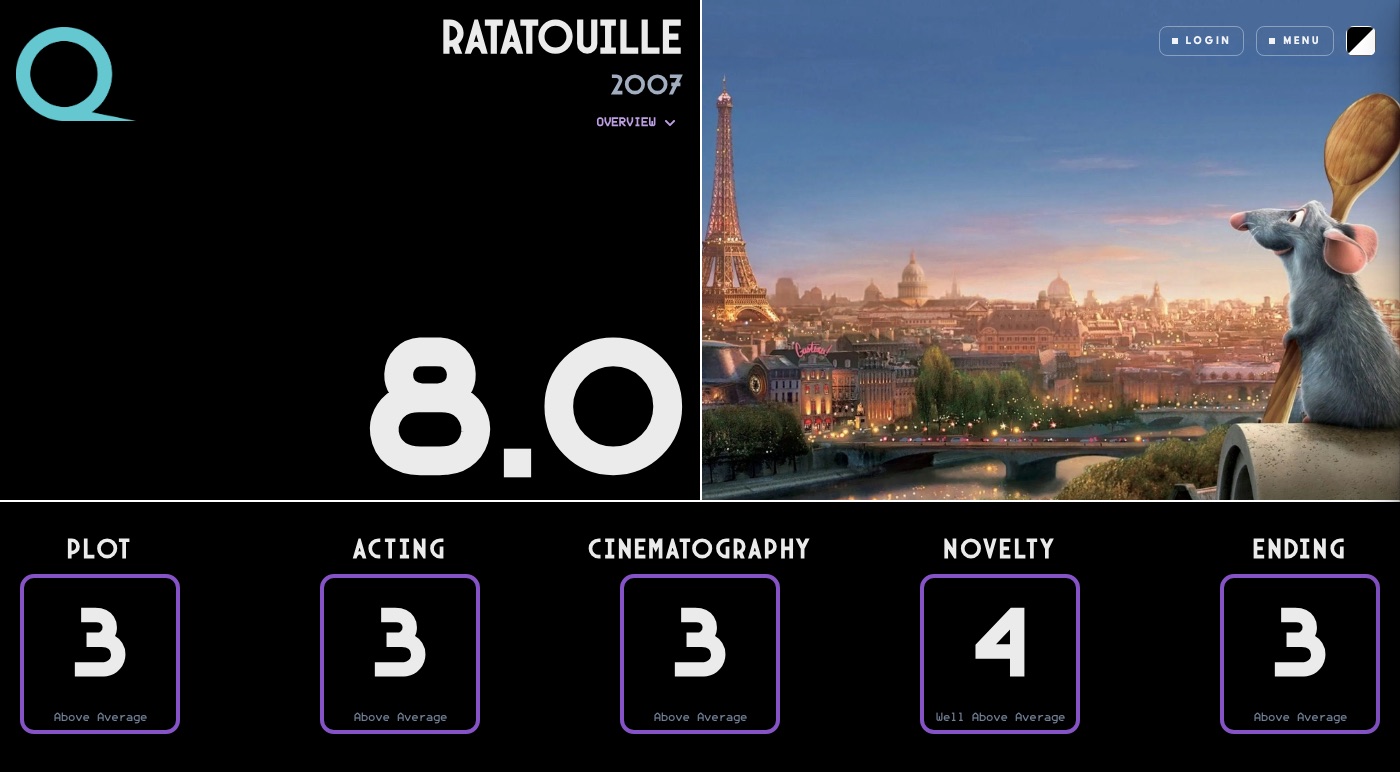
The most honest way to rate a film is to rate the things that actually make it work. Quartile does this with five categories — Plot, Acting, Cinematography, Novelty, and Ending — each scored on the same 1 - 4 scale, with no neutral middle:
No safe three-star shrug — every category demands a real opinion. The five then combine by the simplest formula: add them up, divide by two, and you get a single Q from 2.5 to 10.
Ratatouille on Quartile — solid across the board, for a Q of 8.
You keep the at-a-glance number, but underneath it the score explains itself — and that's where it gets interesting. A film doesn't have to be good at everything. Take The Super Mario Bros. Movie: the animation is stunning — a 4 for both Cinematography and Novelty — but a thin story and flat ending pull it down, and it still lands a very respectable 7.
The Super Mario Bros. Movie — two categories Well Above Average, three Below, and it still lands a respectable 7. Same math, a completely different shape.
Same five-category math, a completely different shape. One star rating would flatten all of that into a single number; Quartile shows you exactly where a film soars and where it stumbles.
See it on Ratatouille: one Q, five specific reasons. A film can't hide a weak script behind great visuals anymore, or a stunning ending behind a slow start — each part stands on its own.
What each category measures
The five aren't arbitrary — they're the elements that actually decide whether a film works:
- Plot — The structured sequence of events, character arcs, and narrative developments that form the core story. Also called storyline.
- Acting — The art of inhabiting and portraying a character convincingly, through voice, movement, and emotional expression, in a way that serves the story and feels authentic rather than performative. For documentary films, this category becomes Narration.
- Cinematography — The artistic vision, tone, look, and feel of the production. Influenced by the quality of the camera work, lighting, and editing. This category includes Soundtrack.
- Novelty — Freshness of aspect, design, or style.
- Ending — The final or concluding part of storyline; conclusion.
Why it's better
A rating should tell you something you can act on. "Four stars" tells you a stranger liked it. A five-category breakdown tells you what to expect — and whether the things you care about are the things this film gets right.
It also turns the whole catalog into something you can search by taste. Because every film carries five structured scores, you can filter by Top in any category — the best-shot sci-fi, the most novel comedy — and land on the exact kind of film you're in the mood for, instead of scrolling forever.
That's the whole idea behind Quartile. Read the story →, or rate your first film →.