A new way to rate films and TV

I got tired of two things: the nightly "what should I watch?" paralysis across a dozen streaming apps, and rating systems where a single score doesn't really tell you enough about a film.
Take the scores we all lean on. Five stars is dead simple, but the three-star middle is a shrug, and one figure can't tell a stunning ending apart from everything else a film is doing. A 1–10 crowd average is the most recognizable scale going — the industry standard — yet nobody can actually say what separates a 7.7 from a 7.8. A percentage is a headcount of positive reviews, not a measure of quality: 95% approval isn't the same as a film being 95% good. Every one of them answers what did people rate it? None of them answers why is it rated what it is — and that second question was the whole thing I couldn't stop wanting.
So I built Quartile, a film discovery and rating platform. The core idea: instead of one ambiguous score, every film is broken into the five elements that actually matter — Plot, Acting (Narration for docs), Cinematography, Novelty, and Ending — each scored on the same 1 - 4 scale, with deliberately no neutral "average" middle:
It forces you to actually take a position on each category instead of lazily defaulting everything to the middle, which keeps the ratings honest.
A score that shows its work
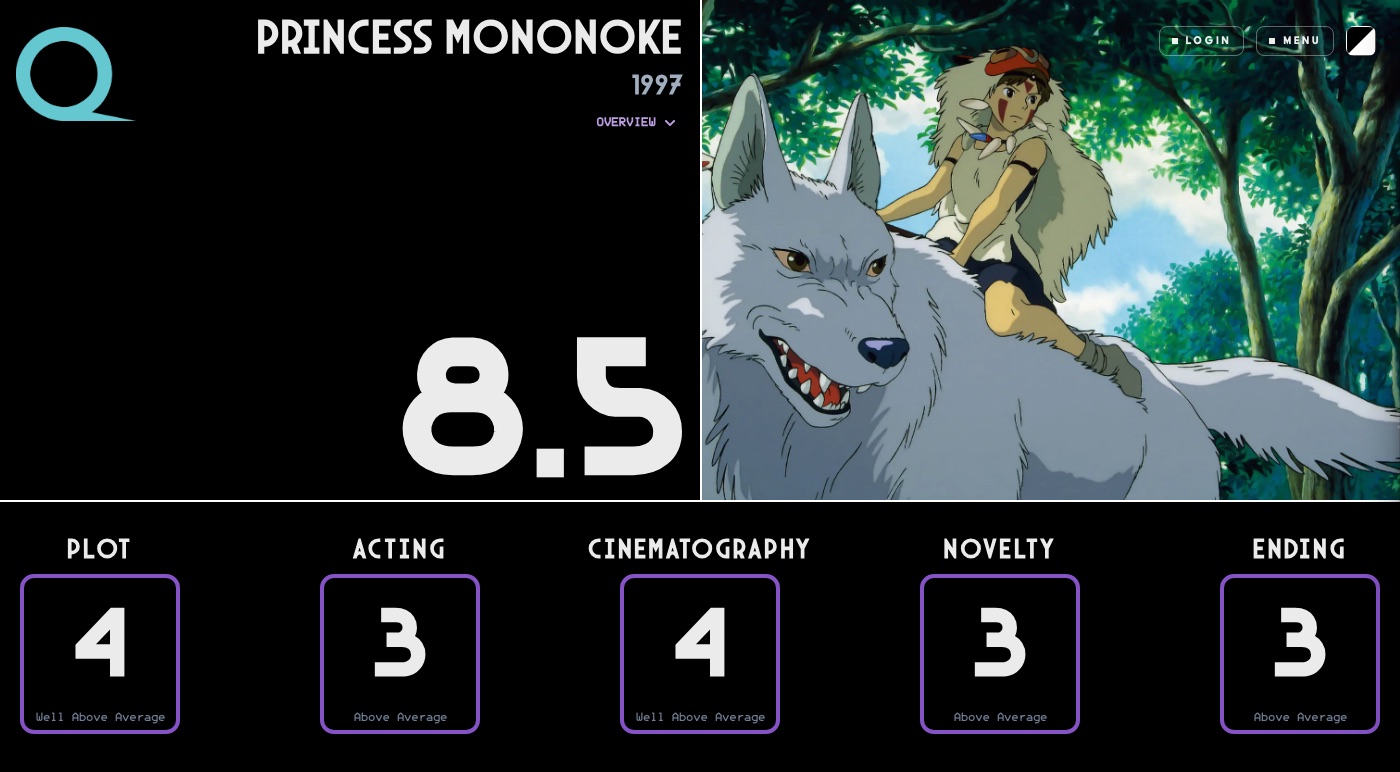
Those five combine into a consistent score out of 10, but you can also see what each category scored, which helps you understand why a film is rated what it is. Sometimes a movie is really good but the ending or the acting is terrible, so the overall score isn't that high — and without the Quartile system you'd have no way to know that, because a single number can't tell you. That's exactly why I built it: I wanted to know why a film was rated what it was. Essentially it's a formula, and some real quality control, for how a film gets rated:
Princess Mononoke on Quartile — its five category scores, summed and halved for a Q of 8.5 (range 2.5–10).
What each category measures
The five aren't arbitrary — they're the elements that actually decide whether a film works:
- Plot — The structured sequence of events, character arcs, and narrative developments that form the core story. Also called storyline.
- Acting — The art of inhabiting and portraying a character convincingly, through voice, movement, and emotional expression, in a way that serves the story and feels authentic rather than performative. For documentary films, this category becomes Narration.
- Cinematography — The artistic vision, tone, look, and feel of the production. Influenced by the quality of the camera work, lighting, and editing. This category includes Soundtrack.
- Novelty — Freshness of aspect, design, or style.
- Ending — The final or concluding part of storyline; conclusion.
Filter by what you're in the mood for
The best part is it lets you filter in really cool ways. You can filter by Top in any category — so Top Cinematography shows only films rated Well Above Average (a 4) there. Top Novelty is one of my favorites, and one of the most unique filters we offer. Then stack it with a genre and a decade: the best-shot sci-fi of the 1980s, the most novel animation of the 2010s, the tightest-plotted thrillers of the '70s. That's where it gets genuinely useful for finding something specific to your mood.
Films and TV
And it's not only films. A great show isn't a long film, so Quartile rates television by season — a series can find its footing, peak, and stumble, and one number for the whole run tells you none of that. Films and shows sit side by side, judged by the same five honest categories.
More than a rating
On top of the rating system you can log the films you've seen, build and share playlists, and follow other users to see what they're watching. The same way you follow friends with good taste in music to find new songs on Spotify, film is a matter of taste too — you can follow friends with good taste in certain genres to find movies you'll actually like.
It's in beta right now — the version of film rating I always wanted to exist. If a single number has ever felt like it was hiding the good part, rate your first film → and watch it break into five. (I'm grandfathering in the first active users, so now's a good time.) Curious about the method? Here's exactly how the scoring works.