Best Letterboxd alternatives (2026)

Everyone has a place they check a film rating — IMDb out of habit, Rotten Tomatoes for the consensus, Letterboxd for the diary. They're all good at what they do. But if you've ever stared at a 7.8 and thought okay, but why — you're not alone. I felt that way for years, and it's why I eventually built my own.
Here are the major film-rating platforms in 2026, who each one is really for, and the one I built to do something different.
IMDb — the encyclopedia
The largest film database there is, and the rating most people check out of habit. But its 1–10 crowd average is impersonal and easy to skew — the most familiar scale there is, sure, yet oddly over-precise: what's the real difference between a 7.7 and a 7.8? All that granularity, and it still never tells you why a film sits where it does. IMDb is built for looking things up, not for building your own taste. A great reference; a weak diary.
Rotten Tomatoes — the consensus meter
The Tomatometer is a brilliant summary of critical consensus — the percentage of reviews that lean positive. But that's all it is: a yes/no tally, not a measure of how good a film is or why. A 95% film and a 75% film tell you how many critics approved, not what actually worked on screen.
Mubi — the curated cinema
Mubi is less a rating app and more a sensibility — a hand-curated stream of arthouse and world cinema with a small, film-literate crowd. Perfect if you want what to watch chosen for you by people with impeccable taste. Not the place to rate and organize everything you've ever seen.
Quartile — rating films by category, not stars
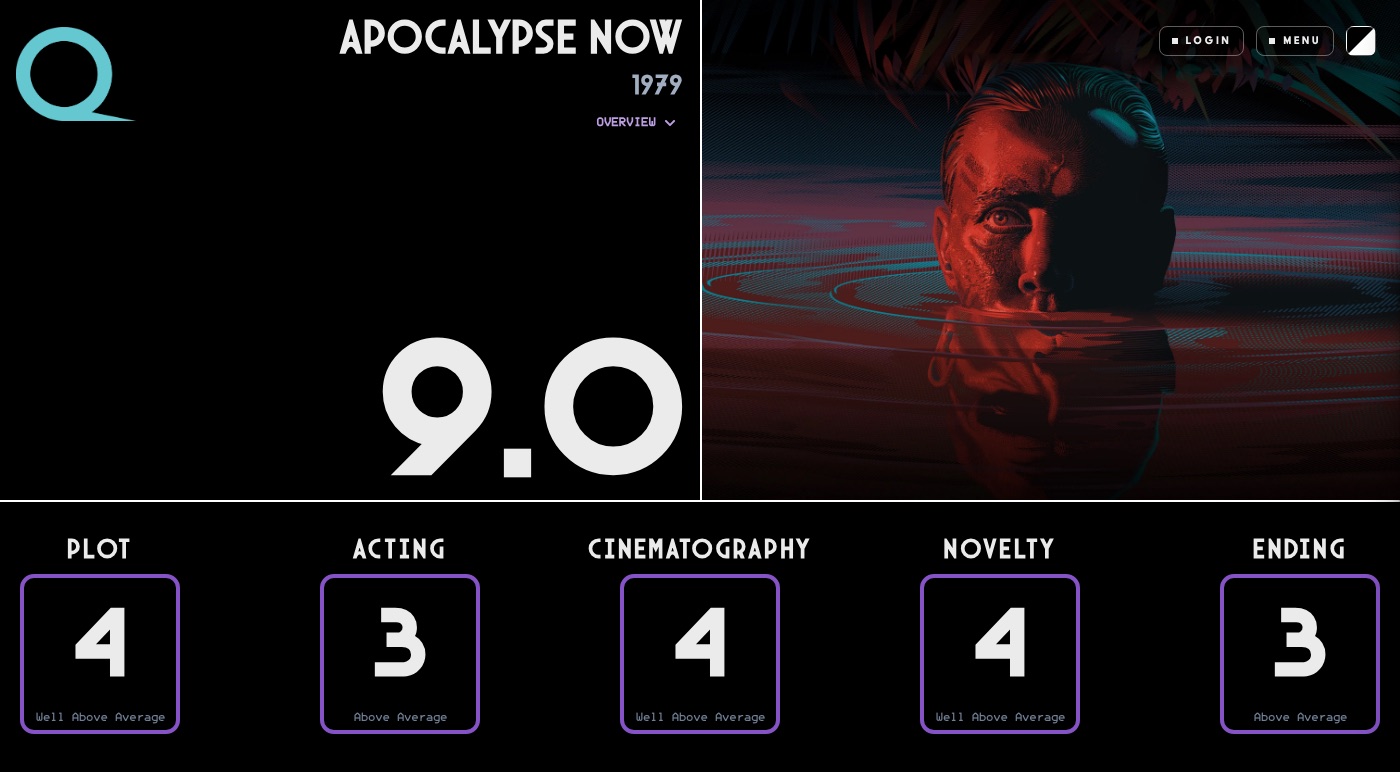
A star rating, a crowd average, a percentage — they all answer the same question: what did people rate it? Quartile is built to answer a different one, why is it rated what it is. It rates every film across five categories — Plot, Acting, Cinematography, Novelty, and Ending — each on a 1 - 4 scale with no neutral middle, on purpose — every category is a real opinion:
They're summed and halved into a single Q score out of 10 (so the scale runs 2.5–10), but underneath it you can see the shape of a film: what it nailed and where it fell short. See how that looks on Apocalypse Now — a Q of 9.0, broken into five separate category scores.
And it's not only films — Quartile rates TV by season on the same five categories, so a great season and a weaker one each get their own read, instead of hiding a whole series behind one number.
Those structured scores also make it a genuine discovery tool: you can filter the whole catalog by Top in any category — the best-shot sci-fi, the most novel action — and stack it with genre and decade to find something specific to your mood. And it's a great way to keep and organize what you watch: every film and show you rate is tracked automatically, you can build curated playlists across films and TV, and you can follow friends to learn from their ratings and playlists.
So which should you use?
It comes down to what you want:
- A reference database → IMDb
- Critical consensus at a glance → Rotten Tomatoes
- Curated arthouse cinema → Mubi
- Understanding why a film or show is good — and discovering & organizing your taste across film and TV, not just logging it → Quartile
If that last one is you, the fastest way to feel the difference is to rate a film you have strong opinions about and watch it break into five categories.