Quartile vs IMDb: a rating that tells you why

IMDb is where the world checks a film's rating, and its database is unmatched — cast, crew, trivia, every title ever made. But the rating itself, a single 1–10 number averaged from millions of votes, is built for looking things up, not for telling you why a film is rated what it is — or what it's actually good at.
One number, no reasons
An IMDb score is the crowd's verdict boiled down to a single 1–10 — millions of real opinions averaged into one figure. And that average is genuinely worth something: the people who actually watched a film are exactly who should be judging it. The problem was never the crowd. It's that one number can't carry the reasons.
A 7.8 tells you a film landed somewhere north of fine. It doesn't tell you whether the story is tight or the ending falls apart, whether it's a visual marvel or a sharp script shot flat. A quietly excellent film everyone mildly likes and an ambitious swing that's brilliant in places and rough in others can read the exact same 7.8. You get the verdict without ever seeing what it's built on.
And step back from IMDb for a second, because every rating scale has its own version of this blind spot. Five stars collapses a film into a single mood, with a three-star middle that's really just a shrug. A percentage counts how many critics approved, not how good the thing actually is. A 1–10 average — the most familiar, industry-standard number of them all — spreads a film across ten decimal-point gradations without ever telling you what any of them mean. They all answer the same question: what did people rate it? Not one of them answers the question you actually care about when you're deciding what to watch — why is it rated what it is?
Quartile: the reasons come attached
Quartile rates every film across five categories — Plot, Acting, Cinematography, Novelty, and Ending — each on a 1 - 4 scale with no neutral middle:
The five combine into a single Q out of 10, so a score is never just a number; it's a shape. Look at The Empire Strikes Back: the categories tell you exactly where its greatness lives, not just that people like it.
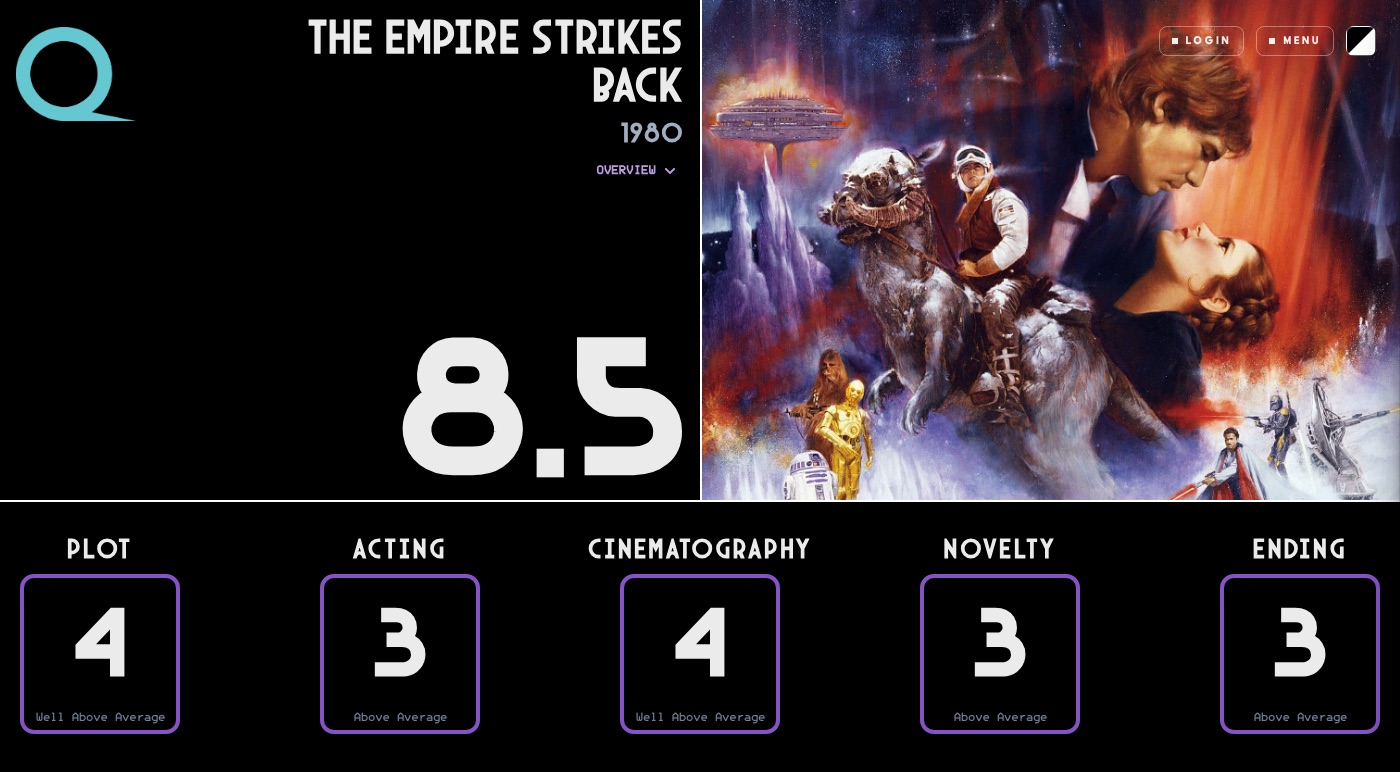
It's the same kind of crowd IMDb has — real people, averaged — just asked five specific questions instead of one. So the verdict arrives with its reasons attached: you don't just see how good a film is, you see what it's good at.
And those five scores double as filters. You always see both the overall Q and the category scores behind it, so you can browse by them: pull up Top Cinematography, or the most novel sci-fi, and search your taste instead of a popularity chart.
Where each one fits
IMDb is the reference: unbeatable for facts, filmographies, and a rough sense of reception. Quartile is for the part IMDb was never built to do — understanding why a film works, and turning your own opinions into something you can organize and share.
Use IMDb to look a film up. Use Quartile to figure out what you actually think of it, and browse the best user-curated playlists to find your next favorite film.