Quartile vs Letterboxd: More than Stars

If you've logged a film this decade, you've probably used Letterboxd. It's a genuinely great app — the diary, the reviews, the community. I have nothing bad to say about it, and this isn't one of those posts.
But I've always had a problem with star ratings, and it took me a while to put my finger on exactly what it was: a star rating is a mood, not an opinion.
I wanted more out of a film rating — that's why I built Quartile.
The problem with one number
Give Blade Runner 2049 four stars and what have you actually said? Four stars because the cinematography is some of the best of the century? Four stars because the story dragged but you forgave it? Four stars as a rounding-up of a 3.5 you feel a little guilty about? One number flattens all of that into a vibe.
And films are lopsided on purpose. A movie can have a stunning ending and a forgettable middle. A performance can carry a weak script. A wildly original film can be rough around every technical edge. A star rating launders those differences away — and those differences are exactly the thing that tells you whether you will like something.
How Quartile works
Quartile rates every film across five categories:
- Plot — is the story well built?
- Acting — are the performances unforgettable? (In documentaries this category becomes Narration.)
- Cinematography — how does it look and move and sound?
- Novelty — is any part of it genuinely new?
- Ending — does the story's finish complete the work?
Each category is scored on the same 1 - 4 scale — and notice what's missing, there's no neutral middle:
That's the point. A 3-out-of-5 is a shrug, and you can't shrug on Quartile: every category forces a real opinion. The five combine into a single Q score out of 10, so you still get a number at a glance. But underneath it, you can see the shape of why.
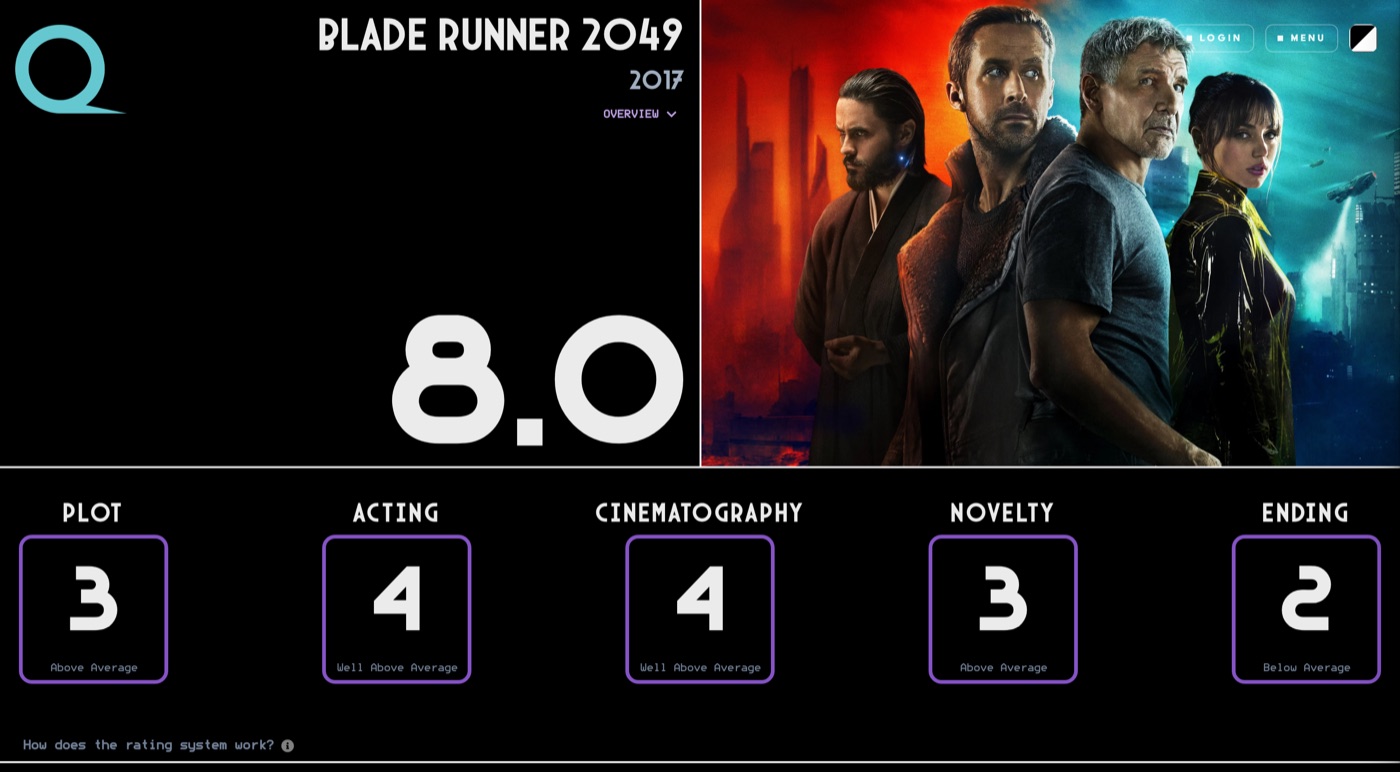
That shape is the whole point. Two films can both land a Q of 8 and be nothing alike: one a flawless crowd-pleaser that plays it safe, the other a messy swing for the fences with a 4 in Novelty and a 2 in Plot. Quartile shows you which is which before you press play.
An honest comparison
I'm not going to pretend one of these kills the other. They're built for different things:
| Letterboxd | Quartile | |
|---|---|---|
| The rating | One score, 0.5–5 stars | Five categories → a Q out of 10 |
| Best for | Logging, reviews, film-diary culture | Understanding why a film works — and discovering & organizing what you watch |
| Covers | Films | Films and TV (rated by season) |
| Neutral option | 3 stars | No middle inside a category — each is a forced 1–4 call, so no rating hides in a shrug (the overall Q can still land at 6.5) |
| Discovery | Genres, lists, popularity | Filter by Top category, stacked with genre and decade — or browse curated playlists |
| Playlists | Lists | Curated playlists across films and TV — mix both in one if you like |
If you want a beautiful diary of everything you've ever watched, Letterboxd is hard to beat. If you want to argue about whether a film's ending earned itself, or find the most novel fantasy of the last five years without wading through three-star mush — that's what I built Quartile for.
Try it on a film you have strong opinions about
The fastest way to feel the difference is to rate something you already have a take on — a film you think is overrated, or a guilty favorite. Splitting a gut reaction into five categories has a funny way of showing you why you feel what you feel. And it makes the arguments with your friends a lot more fun.